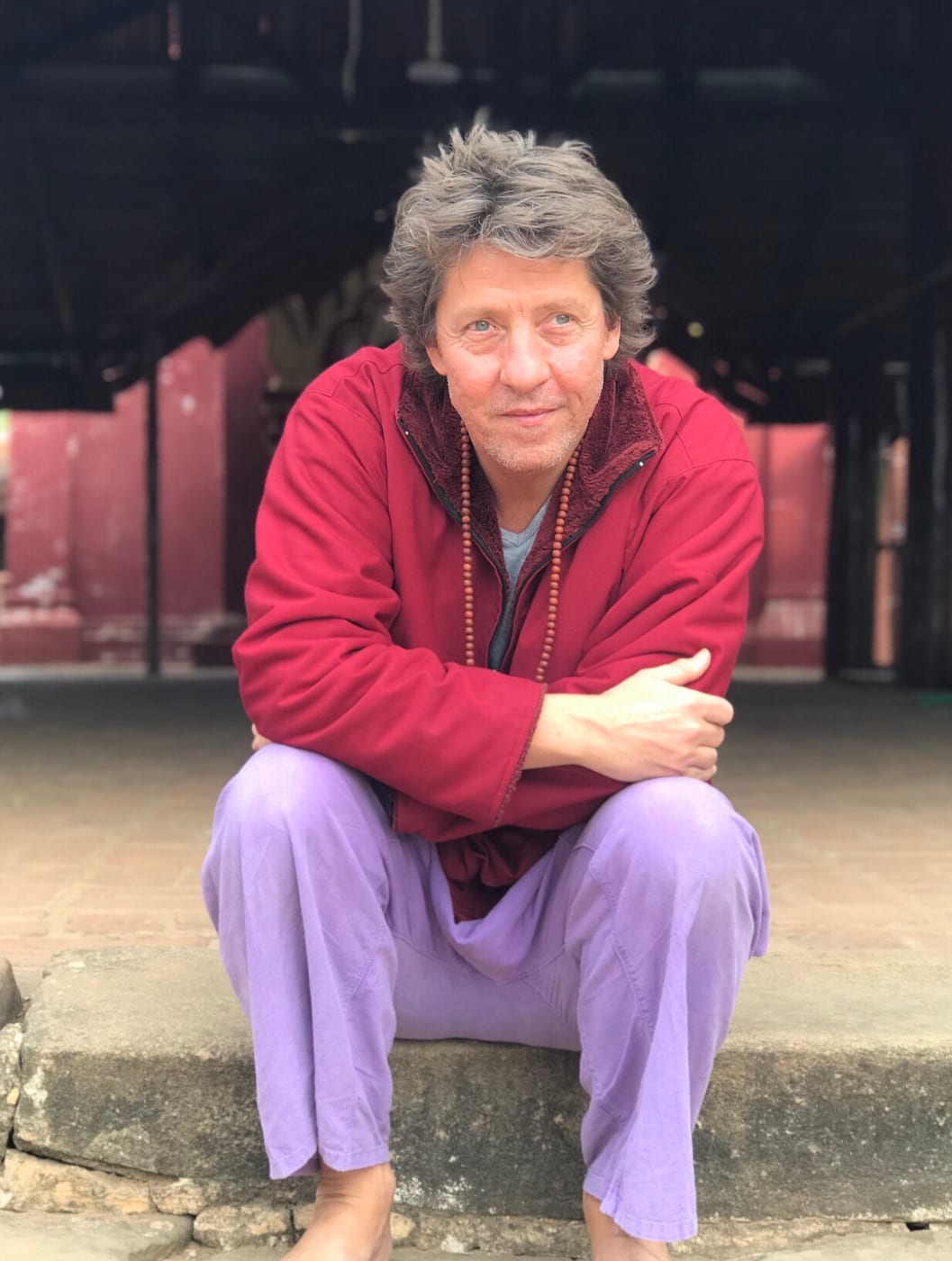
The public record of Burgs's early life is thin. No hometown, childhood or formative anecdote is documented, so this profile starts with the work. What is clear is its length. He is the founder of The Art of Meditation, an organisation that has operated for more than 25 years, and he has hosted retreats for that long. The practice has been the long shape of his working life, not a recent pivot.
The most important personal chapter he has shared is also the most vulnerable. Burgs has written about healing his own brain after a traumatic injury. He does not present meditation as a cure. He describes it working alongside other things, and he found art, calligraphy and other crafts a real help in settling an overactive nervous system.
That experience shaped the character of his teaching. It explains why craft appears in his retreats as a form of practice and not as a pleasant extra. It also explains why his approach to healing meditation is grounded in lived experience, not theory. When he says meditation is a journey into the deepest aspects of being alive, he is speaking from a period when his own nervous system needed tending.
Burgs teaches meditation as an art, not a science. The organisation's own language says that a person who masters their own mind moves joyfully through life and makes an "art of just being." This stance is deliberate. He avoids the "evidence-based" and "neuroplasticity" vocabulary that dominates much contemporary mindfulness, and frames practice as a philosophical and existential undertaking.
His teaching is also unusually broad. It ranges across concentration and mindfulness, vipassana insight practice, healing meditation, and Internal Alchemy, the energetic self-cultivation work that draws on chi kung, breathwork and specific meditations. According to his verified biographical material, this draws on three teachers: Pa Auk Sayadaw of Burma, His Holiness Dodrupchen Rinpoche of Tibet, and Bapak Merta Ada of Bali. Each brings distinct methods. The Theravada vipassana line addresses insight into impermanence and the nature of mind. The Tibetan Dzogchen-influenced approach brings subtle-body work and non-dual awareness. The Balinese and chi kung elements bring energy practice and breathwork.
What makes the arrangement notable is that he does not present these as rival systems. They are offered as successive tools, so a student can stabilise attention first and move toward subtler territory later. Few Western teachers attempt such a synthesis, and he does it without tipping into a grab-bag of techniques.
The online courses are self-paced and combine guided meditations with reading and audio materials. They form a clear progression:
- The Stillness Programme is the entry point, an introduction to the fundamentals of meditation that assumes no prior practice.
- The Art of Meditation (Level 1) develops concentration and mindfulness, the two pillars of what follows.
- Healing Meditation (Level 2) applies those foundations to emotional and psychological wellbeing.
- Internal Alchemy covers the energy-body work of chi kung, breathwork and specific meditations.
- A programme for anxiety offers targeted instruction for people struggling with worry.
Retreats run in the UK and in northern Portugal, and some are held mostly in silence. They include seven-day meditation foundation retreats, vipassana-focused retreats and Internal Alchemy reset retreats. One of the more distinctive offerings is a Tibetan thangka art and meditation retreat, co-hosted with the painter Carmen Mensink, in which visual art practice becomes a vehicle for the same wakeful attention that sitting develops. Calligraphy and other crafts have a place in his retreat programmes more generally, a direct outgrowth of his own recovery.
Beyond courses and retreats, his teaching is available through a podcast, an audio library, books and an autobiography. The autobiography is the place to look for the fuller account of his path, including his recovery.
At present, much of his work lives online, where the audience can reach him at whatever level of commitment suits them. His Patreon community is the most active space, with guided meditations, live sessions and discourses, and the live element lets members ask questions and receive direct guidance. His YouTube channel archives talks and teachings for the general public, and the podcast and audio library let a newcomer hear his voice and pacing before committing to a course. His website, theartofmeditation.org, remains the authoritative source for courses, retreat announcements and his books.
The retreats continue alongside this digital teaching. The online and in-person strands appear to feed one another: the courses build a foundation that the retreats deepen, and the retreats' craft elements give the work a texture that audio alone cannot.
Burgs reaches a particular kind of seeker, one who has tried the app-based, ten-minutes-a-day version of mindfulness and found it thin. His teaching is built for people who want something rigorous and are prepared to commit months or years, which also means it is not for everyone. Those looking for a quick fix, a productivity technique or a fully secularised, religion-neutral method may find the layered curriculum and its Buddhist roots more than they bargained for. He does not require belief, but he does not strip the practice of its contemplative context either.
He also reaches beginners, and this may be the harder achievement. A teacher who can hold an absolute newcomer's hand through posture and attention, while leaving the deeper philosophical dimensions intact for long-time practitioners, avoids both condescension and overreach. The pedagogical patience attributed to him is that balance in practice.
His importance lies in what he resists. In a market that often packages meditation as self-optimisation, he insists it is an art, a way of being alive that cannot be reduced to a metric. His own history makes that claim credible. He found his way back through stillness and through the slow, absorbing discipline of making things by hand. His legacy, so far, is a body of teaching that treats attention as a craft worth a lifetime of study, and that offers an honest, graded path into it for anyone willing to begin.