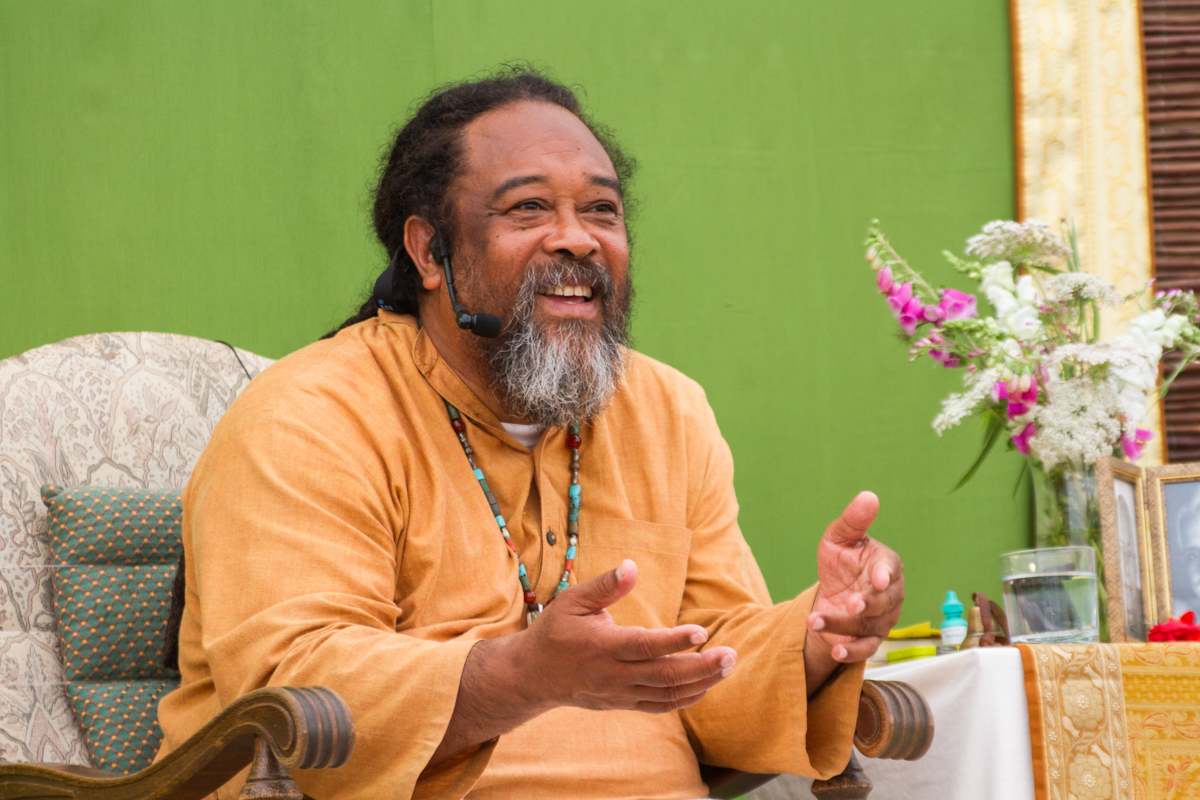

A Mooji satsang unfolds with a distinct rhythm. Sessions typically run two to three hours, beginning with kirtan—devotional chanting accompanied by harmonium and percussion—that settles the room into a receptive state. Then Mooji takes his seat, often draped in white, and opens the floor to questions. What follows is not lecture but live inquiry: students approach a microphone, present their confusion or suffering, and Mooji responds in real time. The exchange might last five minutes or forty, depending on where the inquiry leads. Between dialogues, silence pools. Sometimes the entire room sits wordlessly for extended stretches while Mooji simply looks, waiting for something beneath language to resolve itself.
The format feels less like a workshop and more like a laboratory for consciousness—improvisational, unpredictable, occasionally uncomfortable. Mooji doesn't provide neat conclusions. Instead, he circles the student's question, approaching it from multiple angles, often arriving at a place where language frays and the questioner must either leap or retreat. His method assumes that conceptual answers won't liberate; only direct recognition can.
Mooji returns obsessively to a handful of territories. Chief among them: the distinction between what observes and what is observed, between the "person" you take yourself to be and the awareness in which that person appears. He asks students to locate the "I" that feels threatened, hurt, or seeking—to find where it actually resides. The question isn't rhetorical. He insists students look in the moment, not produce remembered answers from previous teachings.
Another recurring theme: the tendency to identify with psychological content—thoughts, emotions, past stories—rather than resting as the witnessing presence. Mooji speaks frequently about the mind's "trickster" quality, how it generates problems to keep itself employed, how it impersonates you so convincingly that you mistake its anxieties for your own survival imperatives. He distinguishes between "person consciousness" and "universal consciousness," mapping a territory that Ramana Maharshi and Nisargadatta Maharaj surveyed before him.
Surrender appears often in his vocabulary—not as defeat but as the recognition that the separate self trying to become enlightened is the primary obstacle. The one who would attain freedom must be seen through, not improved.
Mooji pushes students to sit with discomfort. "Who is observing this thought?" "Can you find the one who is afraid?" "What remains when the story stops?" These aren't invitations to philosophical speculation but attempts to collapse the distance between question and questioner. He'll often meet a complex narrative with silence, allowing the student's elaborate construction to exhaust itself.
He's particularly interested in the moment when seeking ends—not through attainment but through exhaustion of the seeker. Students expecting consolation or validation sometimes find themselves instead dismantled, their familiar reference points dissolved. The discomfort is part of the method. Mooji works to expose the mechanism of self-contraction, and that exposure rarely feels pleasant.
Mooji's voice carries a distinctive musicality—Jamaican inflections softened by decades in Britain, often dropping into laughter or sudden tenderness. He uses humor liberally, sometimes teasing students gently about their psychological knots, sometimes laughing at the cosmic joke of seeking what you already are. Stories and metaphors appear frequently: the snake mistaken for a rope, the dream character searching for the dreamer, the thief who's already inside the house.
He quotes Ramana and Nisargadatta but doesn't lean heavily on scripture. His authority comes not from textual mastery but from a kind of relaxed certainty, a settledness that students either find magnetic or unsettling. Silence functions as a teaching tool—not merely pause but active transmission, a non-verbal pointing that some students report as palpable.
Mooji's teaching lands most powerfully for those already familiar with non-dual language and hungry for direct recognition rather than incremental practice. Those drawn to devotional surrender, who resonate with guru-student dynamics, often find the format natural. The blend of inquiry and bhakti—the kirtan, the formal approach to the teacher's seat—creates a container that some experience as supportive and others find hierarchical or overly devotional.
The teaching bounces off those seeking practical psychology, gradual development, or ethical frameworks. Mooji rarely addresses trauma integration, shadow work, or relative-world concerns directly. The teaching assumes a readiness to collapse all ground, which can feel destabilizing or insufficient for students whose immediate needs are psychological rather than ontological.
Mooji belongs squarely to the Advaita Vedanta tradition as transmitted through Ramana Maharshi to Papaji and then outward to Western students. His teaching bears the DNA of that lineage: self-inquiry as primary method, emphasis on the Self as unchanging awareness, suspicion of gradual paths. He occupies a particular moment—when Advaita has been largely extracted from its Indian cultural context and repackaged for global spiritual seekers. Whether this represents democratization or dilution depends on who's evaluating.