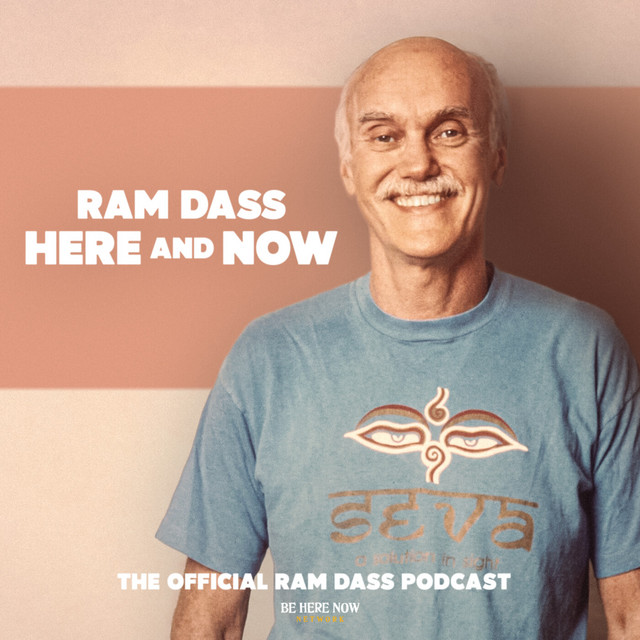

In May 1992, just weeks after the Los Angeles riots had shaken America to its core, spiritual teacher Ram Dass stood before an audience in San Jose, California, addressing one of the most profound challenges facing anyone on a spiritual path: How do we balance the wisdom of detachment with the call to compassionate action?
This timeless question, explored in episode 290 of the Ram Dass Here & Now podcast, remains as relevant today as it was over three decades ago. In our current era of global uncertainty, political upheaval, and social unrest, Ram Dass's teachings offer a beacon of wisdom for navigating the seemingly contradictory demands of spiritual growth and worldly engagement.
The Paradox of Spiritual Living
"So we're talking about the balance between emptiness and compassion," Ram Dass explains. "We're talking about the balance between control with the mind and boundless love with the heart." This fundamental tension lies at the heart of conscious living—how do we cultivate the spacious awareness that comes from recognizing the illusory nature of separateness while still showing up fully for the very real suffering we encounter?
The challenge becomes even more complex when we consider what Ram Dass calls the paradox of "seeing suffering as grace" while simultaneously working to alleviate that suffering. This isn't about becoming callous or indifferent to pain. Instead, it's about developing what he describes as a deeper perspective that can hold both the ultimate and relative truths simultaneously.
From the ultimate perspective, we recognize that all experiences—even painful ones—serve the soul's evolution. From the relative perspective, we remain fully committed to reducing harm and increasing well-being wherever possible. The art lies not in choosing one over the other, but in learning to dance gracefully between both viewpoints.
Practical Wisdom for Turbulent Times
When audience members pressed Ram Dass about dealing with fear around current events—specifically the LA riots—his response was characteristically profound yet practical. He offered an abbreviated version of his famous "Riding the Waves of Change" teaching, emphasizing that "the art form is to be part of that in the universe which can handle change without being reactive to the fear by cultivating the parts in yourself that are not afraid."
This isn't about suppressing fear or pretending it doesn't exist. Rather, it's about recognizing that fear is just one voice among many within our consciousness. By identifying with the witness—the part of ourselves that observes fear without being consumed by it—we can respond to challenging situations from a place of clarity rather than reactivity.
The practical application of this wisdom becomes evident when we consider how to engage with difficult people or situations. Ram Dass addresses the common struggle of practicing compassion with those who are "hard to love." His approach suggests that the difficulty often lies not with the other person, but with our own resistance to accepting them as they are. When we can see beyond the personality to the soul, compassion becomes not just possible, but natural.
The Both/And Approach to Spiritual Growth
What makes Ram Dass's teaching so powerful is his refusal to offer simplistic either/or solutions. He acknowledges that "we're dealing with the tensions between ourselves as separate entities, with ego structures and bodies and so on, and ourselves as part of one thing that has no separateness at all."
This both/and approach recognizes that we are simultaneously individual beings navigating a world of apparent separateness and expressions of universal consciousness experiencing itself through countless forms. Rather than trying to resolve this paradox intellectually, Ram Dass invites us to live it fully, embracing both our humanity and our divinity.
The session also touches on profound questions about consciousness surviving death and how to honor one's spiritual teacher or guru. These discussions reveal Ram Dass's consistent theme: that the deepest spiritual truths cannot be grasped by the mind alone but must be lived and embodied through direct experience.
Timeless Relevance for Modern Seekers
While this teaching emerged from the specific context of 1992, its relevance has only deepened with time. In our current age of information overload, social media anxiety, and global challenges that can feel overwhelming, the need for Ram Dass's balanced approach has never been greater.
His guidance offers a middle path between two common spiritual pitfalls: the trap of spiritual bypassing (using spirituality to avoid engaging with worldly concerns) and the trap of becoming so absorbed in activism that we lose our inner center. True spiritual maturity, he suggests, involves maintaining our connection to the unchanging awareness that underlies all experience while remaining fully available to serve wherever we're needed.
The episode serves as a masterclass in what Ram Dass calls "conscious living"—the ongoing practice of bringing awareness to every aspect of our human experience. Whether we're dealing with personal relationships, societal challenges, or our own inner struggles with fear and uncertainty, the principles remain the same: cultivate the witness, act from love rather than fear, and remember that we are both wave and ocean simultaneously.
As we face our own contemporary challenges, Ram Dass's words continue to offer both comfort and guidance, reminding us that the path forward lies not in choosing between detachment and engagement, but in learning to embody both with grace and wisdom.