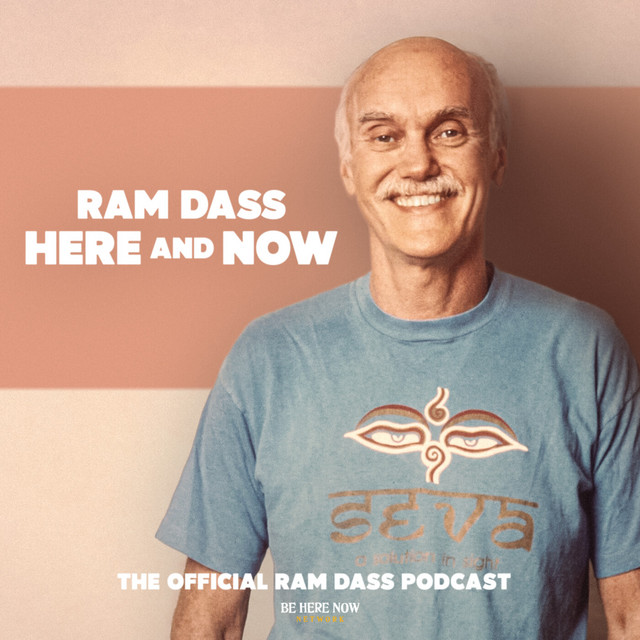

There's something beautifully paradoxical about spending decades pursuing enlightenment only to discover that your greatest gift to the world is your humanity. This is exactly what Ram Dass discovered after 25 years of spiritual seeking, as he shared in a remarkable 1987 keynote address to Buddhist practitioners and psychotherapists.
"I've spent 25 years trying to be divine, and people write and thank me for being human," Ram Dass reflected with characteristic honesty. "I mean, that just seems like a bizarre paradox to me." Yet within this paradox lies one of the most profound teachings about authentic spiritual practice and the integration of Eastern wisdom into Western life.
The Journey from Harvard to the Heart
Speaking to an audience of Buddhists and therapists, Ram Dass traced his extraordinary journey from Harvard psychology professor Richard Alpert to becoming one of the West's most beloved spiritual teachers. His path wasn't linear—it was what he beautifully described as a "spiral path of bouncing back and forth between being in retreat and being in the marketplace of life."
This oscillation between contemplative practice and engaged service reflects a fundamental challenge many spiritual seekers face: How do we integrate profound inner work with the messy, beautiful reality of human existence? Ram Dass's answer wasn't to choose one over the other, but to embrace both as essential aspects of the spiritual journey.
Eastern Wisdom Meets Western Hearts
Ram Dass's deep connection with Tibetan Buddhism, particularly through his relationships with teachers like Trungpa Rinpoche and Kalu Rinpoche, illustrates how Eastern traditions can transform Western consciousness without requiring us to abandon our cultural context. He didn't become a Buddhist monk living in a monastery; instead, he allowed Buddhist teachings to inform his very human work of service, particularly his groundbreaking ministry with dying people.
"I cannot conceivably repay the debt that I feel to the Eastern traditions for having introduced me to myself," he shared with profound gratitude. This wasn't cultural appropriation but rather a genuine integration that honored both his Western background and Eastern teachings, creating something uniquely valuable for his generation and those that followed.
The Sacred Work of Being Present
Perhaps nowhere was Ram Dass's integration of Eastern wisdom and human service more evident than in his work with death and dying. Working alongside people facing their final transition, he discovered that his spiritual practices—meditation, compassion cultivation, and presence—weren't separate from his human empathy and psychological training. They were complementary tools that allowed him to serve more fully.
This work taught him that coming home to being human wasn't a spiritual failure but rather the ultimate spiritual achievement. In a culture that often sees spirituality as an escape from human messiness, Ram Dass embodied a different possibility: spirituality as a way of embracing our humanity more completely.
Levels of Compassionate Service
Through his friendship with Kalu Rinpoche and other Kagyu lineage teachers, Ram Dass explored how we can serve at different levels simultaneously. We can work for social justice, provide psychological healing, offer spiritual guidance, and simply be present with others in their suffering—all as expressions of the same underlying compassion.
This multi-dimensional approach to service reflects the Buddhist understanding that wisdom and compassion are inseparable. We don't first become enlightened and then serve others; rather, our service to others is itself a path to awakening. Every encounter becomes an opportunity to practice presence, to offer love, and to recognize the fundamental interconnectedness of all beings.
The Gift of Authentic Vulnerability
What made Ram Dass so beloved wasn't his spiritual accomplishments but his willingness to share his struggles, doubts, and very human failings. In an era when many spiritual teachers presented themselves as having transcended human limitations, Ram Dass offered something revolutionary: a model of spiritual authority based on authenticity rather than perfection.
This authenticity became even more pronounced after his stroke in 1997, when physical limitations forced him to embody his teachings about accepting what is and finding grace in difficulty. His later years demonstrated that spiritual maturity isn't about transcending our humanity but about embracing it with ever-greater compassion and wisdom.
A Living Bridge Between Worlds
Ram Dass's 1987 address reveals him as a bridge between the contemplative depths of Eastern spirituality and the engaged service that characterizes the best of Western humanistic values. He showed that we don't have to choose between inner development and outer service, between spiritual practice and psychological work, between honoring ancient wisdom and addressing contemporary needs.
His legacy reminds us that the ultimate spiritual achievement might not be transcending our humanity but rather coming home to it with greater love, wisdom, and compassion. In a world that desperately needs both inner transformation and outer healing, Ram Dass's integrated path offers a model for spiritual engagement that is both deeply rooted in tradition and dynamically responsive to the needs of our time.
Perhaps the greatest teaching in this paradox he discovered is that our very human struggles, vulnerabilities, and authentic presence are not obstacles to spiritual service—they are the very qualities that allow us to serve most effectively. In learning to be fully human, we discover our capacity to be truly helpful.